Recently in Gadgets Category

Gadget news, reviews, and analysis.

  1. Jan14

    Connected mobile gadgets TechSession

    SF Tech Sessions is back after a brief holiday break! This month's theme is gadgets connecting people on the move, downloading relevant information and sharing new information with others through cellular and open WiFi networks. I've chosen three startups (two launched within the last 6 months) who are well on their way to changing an existing well-proven category with network smarts. This month's SF Tech Session, Connected mobile gadgets, takes place this Thursday, January 18, from 7-9 p.m. at CNET in San Francisco. Recent Best of CES winners Dash Navogation , Zing Systems, and OQO will present their approach to two-way connectivity on mobile gadgets.

    Dash Navigation

    Dash Navogation is an on-dash car navigation system connected to fresh data streams from the Internet and other Dash devices. A traditional car navigation system shipping with new cars store map data and points of interest (gas, ATMs, restaurants) on a DVD loaded in your trunk. You can purchase a DVD with new data about once a year to find your way around all the new roads and businesses in your area. Luxury models might include real-time data downloaded from your satellite radio provider such as Sirius or XM for an additional monthly fee.

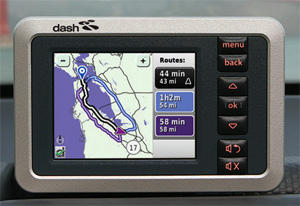
    Dash Express navigation screen

    Dash Express is an after-market car navigation device connected to the Internet over cellular data networks and/or WiFi, downloading and uploading real-time data for a faster trip from point A to point B. In a lot of ways Dash Express is a gadget extended with mashed up web service APIs. Dash uses map and location data provided by Tele Atlas updated every 3 months, historical and real-time traffic data provided by Inrix, local point of interest search powered by Yahoo! Local, and event search using Upcoming. They also hope to create a critical mass of Dash devices communicating their own observed data sets back to Dash central and shared anonymously with other cars on the road through their own web service.

    My favorite two features of the Dash Express are the ability to send information and directions to your car, and the way the computer pays no attention to posted speed limits when calculating the fastest route to your destination. You can send your friend's address to your car through the Dash website while you're sitting at your home computer and the comfort of a full keyboard. The Dash software also knows nobody really drives the speed limit on highway 280, adjusting your trip time for your maniac driving skills down an open stretch of highway.

    Robert Acker

    Robert Acker, Dash's Senior VP of Marketing and a former astronautical engineer at Boeing before planning the future of music at RealNetworks and XM Radio, will demo the Dash Express and its unique approach to connected gadgetry this Thursday.

    Zing Systems

    Zing software powers connected music players taking advantage of Internet connections to listen to and record from Internet radio stations, download new tracks from any open WiFi access point, and share your favorite songs with friends as you walk down the street. Traditionally a portable music player connects to the Internet through your home computer, synchronizing new music, podcasts, and photographs when docked to its base station. New devices such as Microsoft's Zune player create an ad-hoc network to share songs or photos with the same hardware and software nearby.

    SanDisk Sansa Connect

    Zing software currently powers the Sirius Stiletto and upcoming SanDisk Sansa Connect music players. You can record tracks directly from satellite radio, or connect to your PlaysForSure music store for new tracks on the go. You can view recommendations and share your favorite tracks with friends as you walk around the city, touching the data cloud whenever you're near an open access point. Zing has a few deals with paid WiFi networks to help its devices connect without issue or payment while you roam around the city.

    My favorite two features on current Zing devices is the ability to switch to the best available music stream and the ability to download new files from your music player. If you own a Stiletto the device software will determine your strongest signal source, playing the satellite stream or connecting to a nearby WiFi access point to stream the same radio channel over the Internet depending on your best form of connectivity. If you subscribe to a subscription music service such as Napster you could view a new recommended track (think Last.fm) and download it and listen almost right away from anywhere with Internet access.

    Tim Bucher

    Zing founder and CEO Tim Bucher will demo current products and share the company's vision this Thursday. Tim has a long gadget history, leading the engineering efforts of Apple's iPod, UltimateTV, and Microsoft's Xbox before founding Zing.

    OQO

    OQO model 02

    OQO compressed features of a notebook computer down to the size of a handheld running Windows Vista in about 18 cubic inches of space. The company just released its Model 02 computer last week, adding three flavors of WiFi and EV-DO (9 antennas total) for Internet access from almost anywhere. OQO is often compared to Microsoft's Ultra-Mobile PC initiative announced last year even through the company seems focused on core business tasks in as small of a package as possible.

    The OQO Model 2 docks to your desktop, powering standard desktop accessories such as an external display, keyboard, mouse, and optical drive. The concept brings up memories of the PowerBook Duo from the early 1990s, when ultra-portables became easily synchronized through a desktop docking station.

    OQO marketing lead Bob Rosin will share the company's views on mobile connected gadgets this Thursday.

    Event info

    If you live in the San Francisco Bay area you can play with the latest pre-release hardware from local startups Dash Navigation and Zing Systems this Thursday evening at CNET from 7-9 p.m. More information is available on the SF Tech Sessions website.

    Please RSVP on the SF Tech Sessions site to help me prepare enough seating, pizza, and beer for everyone.

  2. Jan07

    Sony adds RSS to televisions

    Sony KDL-R70XBR

    Sony's latest HDTVs will support an optional component capable of streaming Internet video and downloading content defined using RSS syndication. The BRAVIA Internet Video Link is a small optional module attached to the back of your HDTV and connected to your home broadband network over Ethernet. Price and availability are still unannounced, but the first televisions supporting the new module will be available this Spring.

    PSP XMB interface

    The BRAVIA Internet Video Link operates independently without the need for a separate gateway computer on your network. It uses the Xross Media Bar (XMB) interface already present on a PSP to browse feed lists, individual items, and their individual enclosures.

    Your TV now subscribes to RSS. Crazy!

    Gizmodo has some hands-on pictures of the BRAVIA Internet Video Link and its interface.

  3. Dec28

    Grope-worthy Windows Vista laptops

    The consumer version of Microsoft's Windows Vista operating system is only a month away and bloggers are already receiving their first review units. So far the review units sound pretty boring compared to the Windows Vista capable hardware available throughout the world. I put together my own list of five grope-worthy notebook computers ready to test Vista on multiple fronts.

    You might prefer a silent ultra-portable or a power-hungry luggable. You can search for WiFi without ever opening your computer or get online anywhere with cellular broadband. The latest Apple hardware runs Vista without a problem too.

    I expect this entire list will be out of date in two weeks as companies announce their latest products at CES but it's a fun snapshot across a variety of portable hardware.

    Samsung Q30-SSD

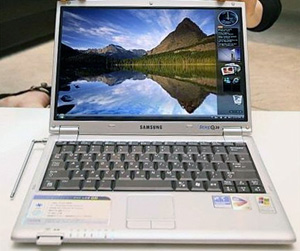
    Samsung Q30-SSD laptop computer

    The Samsung Q30-SSD ditches the hard drive, storing all your data on 32 GB of flash memory. Flash memory is 30 grams lighter, twice as shock-resistant, and about 3 times faster than a laptop hard drive. The 12" laptop is completely silent and weighs 2.5 pounds.

    The Samsung Q30-SSD also has a built-in TV tuner if you live in a region with DMB.

    Asus W5Fe

    Asus W5Fe notebook computer with PortalPlayer Preface

    The Asus W5Fe is one of the first laptops with an external display, displaying widgets on your computer's outer casing. It's part of the Intel Newport series of laptops and powered by the PortalPlayer Preface platform. You can check for WiFi hotspots within range, get a quick glance of your e-mail, or check out any Microsoft gadget through Windows Vista SideShow.

    Lenovo Thinkpad T60

    Lenovo ThinkPad T60

    The Lenovo T60 features Cingular HSDPA as a built-in option, hooking you up with an encrypted 700 kpbs connection at low latency throughout major U.S. cities. Wireless data access definitely changes how you use your laptop on the go, providing access to e-mail and other timely data most anywhere.

    If Windows Vista fails to impress you can install Ubuntu Edgy Eft on the Lenovo T60 in no time.

    Alienware Aurora mALX

    Alienware Aurora mALX

    The Alienware Aurora mALX will render the fancy graphics features of Vista effortlessly, powered by two parallel-proceessing Nvidia graphics cards and 64-bit AMD Turion CPUs. The 19" notebook computer has 4 speaker surround sound and even has its own subwoofer.

    The Alienware mALX weighs over 15 pounds; that's about three MacBooks. It's a bit excessive for most people but should yield a Windows System Performance Rating above a 3.

    Apple MacBook Pro

    Apple MacBook Pro 15-inch

    The Apple MacBook Pro lifts heavy loads thanks to a 64-bit Intel Core 2 Duo processor and 3 GB of RAM. The 15.4" laptop is light for its size, weighing about 5.6 pounds, and can run a variety of operating systems beyond Mac OS X.

    Fire up Boot Camp and you have a Windows Vista PC ready to go with access to full system resources inside of a stand-alone boot sequence. It's possible to virtualize the operating system, but you will risk taking away some much-needed resources from demanding Windows Vista software.

  4. Nov16

    EmTrace WidgetStation

    WidgetStation

    A Korean company specializing in smartphone development is releasing a hardware device next year focused on widgets. The WidgetStation from Emtrace Technologies has both a mono and color LCD and receives content update over Ethernet and/or USB connections. It's a mini computer with an ARM processor, NAND flash memory for local storage, and RAM.

    The mono LCD is designed for long-term display items such as a clock or weather while the color LCD displays built-in and customizable content from the Internet or your desktop, including support for audio playback.

    Emtrace's past developing for smartphones in a mobile-heavy culture such as Korea should give it a leg-up in this emerging market of widget hardware producers. Competitors include PortalPlayer Preface, Chumby, and Ambient Devices. Akihabaranews loves the WidgetStation, which has already won a CES Innovations award in the Personal Electronics category.

    Will people use a dedicated hardware device for widgets? I think so. I've eyed Internet-enabled photo frames, digital audio players, weather stations, atomic clocks, and more for my own personal use but price and bulk usually keeps me away. Combining functions on one device remotely configurable from the Internet makes a lot of sense and could be pretty popular.

  5. Jun17

    Fabrik storage at home and in the clouds
    Dave Tang, Fabrik

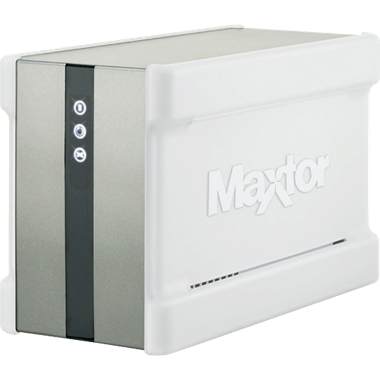
    Fabrik creates smart networked attached storage software and online storage to help home users backup and share their digital media assets such as music, photos, and videos. Fabrik's founders were previously executives on Maxtor's OneTouch line of storage products, a product line with hundreds of millions of dollars in yearly revenue, and have spent many years thinking about the networked and online storage space. Fabrik's software is included in Maxtor's new Fusion line of networked storage. The first product launched on Thursday, and Dave Tang of Fabrik came by SF Tech Sessions on Thursday evening to show us the new hardware and management services.

    Maxtor Fusion

    The Maxtor Fusion networked hard drive includes half a terabyte of storage, Linux and Apache onboard, and automatic online backups. You may choose to use the hard drive as a web server, sharing your photos, videos, and music with the world. The device works with Mac and Windows out of the box and supports up to 12 user accounts to keep files private or under a set storage allocation. The networked drive launched on Thursday and is currently available at J&R Computer World for $800. An older Maxtor 500 GB networked drive from J&R costs $450, a 40% difference.

    Fabrik photo browse

    Fabrik has a slick browser-based interface to help people interact with their files on the local network or online. They call the technology a weblication, and it's a slick use of JavaScript and browser plugins to create an integrated media experience within a web browser. The software automatically retrieves ID3 tags and album art for music placed on the device. If you can listen to a music file instantly within the browser, or watch videos in a JavaScript overlay.

    Fabrik share

    Built-in to the Fabrik file browser is a sharing function allowing anyone to place a media file in their blog or on their MySpace account. There are even specially configured options to add a photo album or slideshow to your MySpace page. This feature is slick, and allows home users to share large files using their home broadband bandwidth.

    Fabrik will open up its online storage service to beta users in the next few months. Usage plans are expected to cost $2-$3 as a base plan and $5-$10 for larger amounts storage. General availability is expected by the end of the year.

  6. Jun14

    Webcams built for blogging

    LifeCam VX-6000

    Microsoft introduced new cameras yesterday allowing users to post the camera's 5 megapixel images to their Spaces account with one button click. Easy video posting shouldn't be far behind. This new hardware might be the first mass-market webcam with push-to-blog built-in.

    Creative Live Cam Voice

    I've been eyeing the Creative Live! Cam Voice and its adaptive array microphones with better specs for the same retail price. It looks like good hardware for podcasts and video chat.

  7. Apr05

    PodSession: wireless broadband

    3G logo

    I want high speed Internet everywhere. Forget the WiFi hotspot locator attached to your keychain or the questionable reliability of a local cafe, I want a reliable and fast connection everywhere I go, even if it's on a train or car moving 60 mph. Thankfully the cellular phone industry is up to the task and rolling out wireless data connections with up to 3 Mb/s in the San Francisco Bay area and other large metropolitan areas throughout the U.S.

    These new mobile technologies are known as EV-DO or HSDPA depending on the carrier and are delivering high enough speed with low latency for us to start taking it seriously. The technology is built-in to many mobile phones and even a few laptops and getting online anywhere might be as simple as a $8 USB or a $100 specialized PC card and a data plan costing around $60 for unlimited data usage.

    In this week's PodSession Om and I discuss the latest wireless broadband offerings from major U.S. carriers such as Sprint, Verizon, and Cingular available today and in the next 6 months. What would you do with a 1 Mb/s always-on connection in your car, pocket, or on your laptop? How would it change the types of applications you develop or the way you seek out new information?

    If you have an ExpressCard 34 slot in your laptop, help is on the way! Novatel will introduce a EV-DO card in about 5 weeks that will work with your MacBook Pro and other laptops using the new card format.

    This week's podcast, Wireless broadband, is 22 minutes long, a 10 MB download.

  8. Mar27

    Cablevision tests remote storage DVR

    Cablevision plans to give its more than 2 million digital cable customers access to 80 GB of remote storage for less than $10 a month. Digital cable boxes would receive a software upgrade allowing a subscriber to select favorite programs for recording on Cablevision's servers. You can record two programs simultaneously while watching a previously recorded show.

    These types of services are only the beginning of what broadband providers are able to offer their customers on-demand over a high speed network. In the future there may be a channel produced by the cable company on a specialty subject such as high school sports or cooking and never broadcast but available in a time-shifted environment.

  9. Jan09

    Gadgets in the living room

    The latest episode of Om and Niall PodSessions is now available for your listening pleasure. This week Om and I talk about the latest consumer electronics announcements from CES over the last week and some of the emerging trends for new gadgets in the living room.

    I liked the Intel Core Duo announcement and its energy-efficient design. New laptops utilizing the technology have over 11 hours of battery life! I was also impressed by XM Radio's new XM Passport hardware, a tiny 1.5" square satellite radio tuner that can be inserted into multiple devices similar to a SIM card.

    Om rants about how Silicon Valley can't create consumer electronics devices, why Google and Yahoo! should not be giving keynotes at a consumer electronics show, and asks why no one is making more consumer-friendly gadgets.

    This week's episode, Geeking Out the Living Room, is 20 minutes and 53 seconds in length, a 9.6 MB download.

    Tags: , , , ,

  10. Jan04

    Pacific Digital WiFi picture frame with Windows Vista features

    Pacific Digital wireless picture frame

    Pacific Digital is also showing off a WiFi picture frame at CES in Las Vegas. The new MemoryFrame products will connect to Windows Vista PCs using Windows Media Connect, Windows Connect Now, and Vista's integrated RSS features.

    The picture frame can connect to other PCs on a home network using WiFi and display shared content. I could not find any pricing information but current 10.4" wireless picture frames from Pacific Digital cost about $400.

    Tags: , ,

Niall Kennedy Niall Kennedy is a web technologist in San Francisco, California in the United States. I am very interested in the world of... MORE »

Search this weblog:

Subscribe:

Recently Popular

Archives: Popular Categories

Sites: More from Niall