Recently in Mac Category

Software created for Apple's Macintosh operating system.

  1. Sep16

    Inside the iPhone App Store acceptance process

    Apple's iPhone OS App Store is a little over two months old and already the focus of both hype and fear among members of the press. KPCB has already invested more than $30 million through its iPhone-specific fund. Established companies are writing iPhone applications for the first time. A few applications have been banned, as expected with most platforms. Apple's relative secrecy regarding the iPhone platform and distribution policies have caused market uncertainties in need of some further clarity. In this post I will examine the iPhone OS 2.0 platform and the iPhone App Store from the point of view of Apple and other hosted storefront providers.

    As I write this post there are over 3400 applications available from the iTunes App Store. 90% of those apps are available for both iPhone and iPod touch. 76% of App Store listings require payment ($1 or more). Developers may distribute an iPhone OS 2.0 application directly to handsets using their own infrastructure or distribute through Apple's App Store built-in to iTunes and iPhone OS.

    1. Inside the App Store
    2. Podcaster rejection
      1. Submitting to App Store
    3. Ad-Hoc Distribution
    4. Summary

    Inside the App Store

    Apple's iPhone App Store connects developers large and small to millions of iPhone OS devices around the world. Apple handles payment processing, international business licenses, distribution, marketing, and delivery of applications to iPhone and iPod Touch devices over WiFi, cellular data, and tethered experiences. App developers may list items for sale in Apple's App Store in exchange for a consignment fee of 30%.

    Carrying third-party content inside your store and on your devices does carry some risk. Developers pay to access the iPhone developer program, sign their applications with unique keys, and assume some of the support burden for their applications. There are a few obvious reasons why a platform such as iPhone might choose not to carry an application in its storefront:

    • Chargebacks. Buyers frequently return your product for reasons including buyer's remorse or just receiving a different product than they expected. The "I Am Rich" $1000 iPhone app carries a heavy chargeback risk.
    • Insufficient differentiation. App authors should be able to submit an application to App Store and expect there won't be a knock-off product sold directly alongside. Open-source applications can swap out an application title and submit the app as their own without adding new functionality.
    • Misleading marketing, including trademarks. Don't misrepresent yourself or your product or cause obvious confusion.
    • Horrible customer experience. Apple will recommend interface designers who can assist you with visual aspects of your application. Long load times or heavy resource utilization might will make both you and the platform look bad.

    Podcaster rejection

    The Podcaster application was initially rejected for redistribution through Apple's iPhone App. I downloaded a copy of the app, version 1.0.9b, directly from the developer, installed it on my iPhone, and reviewed the app from the point of view of the Apple based on existing publications and guidelines.

    Podcaster navigation screen

    Navigating the tab bar to content sections such as newest podcasts or featured podcasts brings up a splash advising 3-5 minute wait times before content is returned. Red flag. My previous search input does not disappear when I change navigation modes.

    Podcaster for iPhone add podcast confirmation

    The developer used a single button action sheet with a vibration action to confirm each new podcast download. Apple adds a badge to the Downloads tab for a similar action in iTunes. The user has to dismiss a confirmation sheet for every new addition.

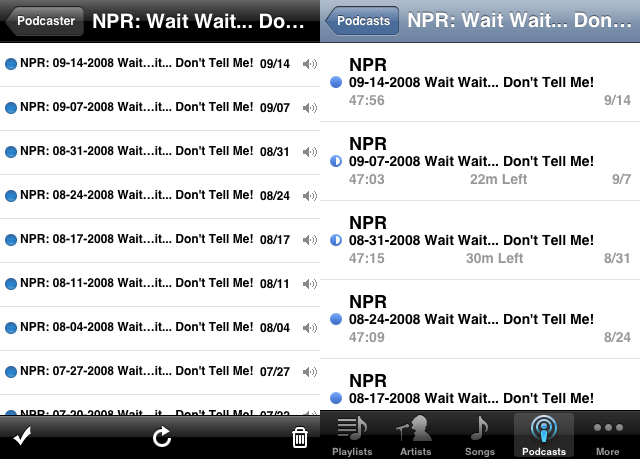
    Podcaster 1.0.9 compared to iPod podcasts 2.1

    Pictured above is a view of the same podcast in Podcaster and iPod. Duplicate functionality when tethered but Podcaster does provide over-the-air updates direct from the handset. Podcaster has some obvious errors with text display in the regular table view but the display does work. Displaying the sound disclosure indicator on every row is a bit overkill: Apple only includes this disclosure indicator when the audio file is currently playing. Small fit and polish issue.

    Submitting to App Store

    Podcaster submitted the first release candidate of their iPhone application to iTunes Connect, App Store's web-based management tool, on August 14. Application release notes are available through the developer's Twitter feed. The version submitted to Apple in mid-August had problems downloading and playing many podcasts including FeedBurner's redirect URLs or large downloads (likely a Range issue). On September 12 Podcaster heard back from Apple regarding their App Store submission. The $4.95 application was not accepted for distribution through App because it it duplicates the functionality of the Podcast section of iTunes.

    The developers resubmitted Podcaster to iTunes Connect on September 13 with a new description before launching a media campaign and ad-hoc distribution.

    Ad-Hoc Distribution

    iPhone application distribution

    Apple designed Ad-Hoc distribution for direct distribution of iPhone OS applications. Each application build is limited to 100 provisioned handsets. Ad-Hoc distribution is a primary distribution mechanism for beta testers, classrooms, workshops, or corporate environments that do not desire worldwide distribution through App Store.

    As of yesterday afternoon Podcaster had provisioned 1130 devices for distribution across 12 different copies of the application hosted on Google Code. Each new uploaded build included up to new 100 authorized devices after the publisher received payment via PayPal. It's stretching the Ad-Hoc distribution model a bit but the application may have collected approximately $11,000 over the weekend through suggested donations of $10 per handset. At the time of writing Apple has not pulled the application or developer certificates from their central certificate authority.

    Summary

    It's not always clear what Apple is up to but there are legitimate reasons to not carry an item for sale in your store. iPhone OS will continue to be a popular development platform even if Apple is overwhelmed with interest and developer support. The best developer information comes from within the confines of ADC, WWDC, and iPhone developer programs, and other privileged access forums restricted by Apple and its partners.

  2. Jan05

    Mac small business dinner January 10 in San Francisco

    I am organizing a dinner for Mac small business owners and developers on Wednesday, January 10, at Chaat Cafe in San Francisco starting at 6:30 p.m. Next week's dinner extends the tradition of MacSB meetings held during each year's Macworld and WWDC conferences in San Francisco, bringing together small software businesses within the Mac developer ecosystem to meet face-to-face, reflect on Apple announcements, and share tips and war stories.

    Google Map of Chaat Cafe in San Francisco

    Chaat Cafe is located at 320 3rd Street (corner of 3rd and Folsom) in downtown San Francisco, one block from Macworld and the Moscone conference center. The restaurant has free WiFi and power outlets near some tables, so bring your laptop to show off your latest creations. You will order food and drink individually near the restaurant entrance and pay only for what you personally eat or drink (typically less than $10). Metered parking is free after 6 p.m. or you may park in the building's parking garage (enter on 3rd Street) with two hours of validated parking if you choose to drive.

    Anyone is welcome to come join us. People with some expertise in small business services are especially encouraged as there are generally many questions raised and good knowledge sharing. At last year's dinner recent Cocoa converts Potion Factory connected with Karelia Software and others to discuss the impact the latest version of iLife might have on their publishing tools. Plasq found a new employee for their small team while others learned the ins-and-outs of online payment systems, marketing, and testing. A few fans of Mac software came by to meet their favorite software creators. Lots of fun.

    I have warned the restaurant staff to expect a big crowd, but you can help make things run a bit smoother by leaving a RSVP in the comments of this post or on Upcoming.org.

  3. Jan02

    Apple Dashcode developer preview available for download
    Dashcode icon

    Apple released a developer beta version of Dashcode, a widget development environment included in its upcoming Leopard operating system. The preview software is available for Tiger until July. (via Brent Simmons)

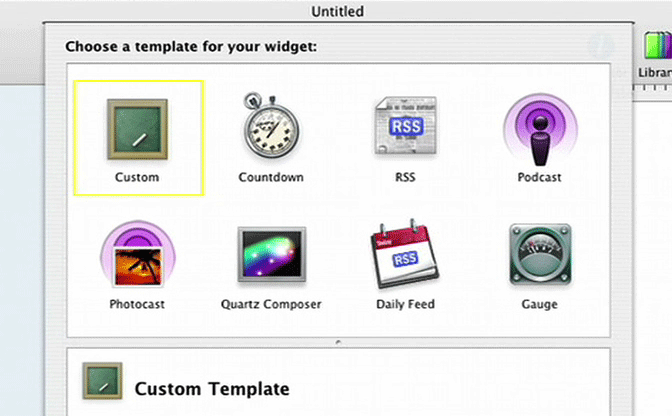
    Dashcode template selection

    Dashcode lets anyone design a new widget through a drag and drop interface or by directly editing the underlying code. Bundled widget templates include a countdown timer, latest items from a web feed, web feed single item view, podcast, photocast, and an activity monitor. Dashcode will debug your Dashboard widget code placing all of your files within the appropriate package and generates additional nice touches such as a configuration screen and widget previews. I was able to create a few widgets by simply dropping a feed URL onto a template file and picking a name.

  4. Aug07

    OS X Leopard Server

    64 bit OS X server apps

    The next version of Apple's server software, codenamed Leopard Server, includes a few new features for the early adopter web crowd and their organizations. Ruby on Rails, podcast production, wikis, blogs, and grid computing are just some of the features built-in to the new server OS.

    The new features redefine what's possible away from a Microsoft-centered world of Exchange and Sharepoint, opening new possibilities through a combination of open-source software, industry-standard protocols, and Apple's friendly interface and design. Small workgroups using Macs or Windows should be able to rack an Xserve and be happy.

    Web server

    Leopard web servers

    Leopard server has support for PHP, JSP, and Ruby on Rails accessible from a simple administrative interface. You can easily turn on Apache HTTP Server, Tomcat, JBoss, or Mongrel backed by MySQL 5.

    iCal Server

    CalDAV Apple

    Apple will release an open-source calendar server at its new codebase, opensource.apple.com. The new calendar server uses CalDAV for exchanging data with applications such as iCal 3, Mozilla Sunbird, Chandler, and Microsoft Outlook. The server includes scheduling, the #1 thing Outlook + Exchange enterprise users seem to miss when switching off a Microsoft intranet.

    Podcast Production

    record button

    Leopard server lets you record podcasts inside of a web browser and stored on your server. If your network supports Xgrid your podcast encoding will be distributed around to any nodes with free cycles. The server records audio and video from Firewire and USB peripherals as well as your computer's built-in mic and iSight. The encoder outputs your recording into formats suited for a web page, iTunes desktop subscription, iPod, or even a cell phone. The server also has privilege levels built-in allowing you to specify who can create and upload podcasts to your server.

    Team sharing

    wiki server apple

    Teams can share information using a wiki, blog, calendar, and mailing list all integrated for easy collaboration. The wiki supports drag and drop editing, a WYSIWYG authoring interface, and feed subscriptions right in your product team dashboard.

    IM Federation

    iChat Server 2 allows your local users to chat with other XMPP systems such as Google Talk and vise versa. You can automatically generate buddy lists for your users as well.

    Just a few of the features in OS X 10.5 "Leopard" Server due out next year. Your Xserve is now Web 2.0 compliant!

  5. Jul25

    OpenDarwin shutting down

    Mac OS X open-source community site OpenDarwin announced it will shut down in the next couple months. The site was the center of discussion and development of WebKit (the code behind Apple's Safari browser and Nokia's Series 60 browser), DarwinPorts, and other projects.

    It's too bad the projects will now all disperse, and I can't help but wonder if the move was influenced by something to be announced at Apple's Worldwide Developer Conference in a few weeks.

  6. Jul15

    Web 2.0 tag cloud laser etching

    Tag cloud etched PowerBook

    Mac geek Dan Lurie took his PowerBook to Squid Labs yesterday for a custom laser-etched cover. Dan designed a tag cloud full of Web 2.0 buzzwords for the world to see.

    He'll definitely have fun at the next Web geek gathering. I have a feeling most of the buzzwords will end up a historical blip like so many of the companies in the Monopoly .com edition I have at home.

    If you're coming to San Francisco for WWDC start designing your etched covers now! There are a few laser etching shops in the Bay area.

  7. May01

    New Mac ads poke fun at Windows

    Get a Mac

    I like the new Get a Mac ads Apple introduced tonight. The messages are simple and conversational with just one or two competitive points each. Less viruses, less restarting, better applications built-in for editing photos and websites, as easy as your iPod, simple connectivity, and a really good value are the themes communicated throughout.

    The Get a Mac campaign also promotes podcasting support as a good reason to switch.

  8. Apr10

    PodSession: You're being watched, and Macs now do Windows

    Om and I received a variety of feedback last week as podcast listeners stood up against research reports about podcasts and their audiences. Some people thought a 20-minute discussion of hot tech news was just right and others wanted even shorter, more digestible chunks. This week Om and I recorded two 10-minute podcasts to try something new and introduce a little variety. It was also tough to pick just one topic this week since both Apple and Google had big announcements last Wednesday.

    You're being watched

    Your cellular carrier knows where you are at all times. Pinpointing your location helps connect phone calls and lets emergency personnel send help to your location even if you have no idea where you are. New ad-supported networks such as Earthlink and Google's municipal WiFi network in San Francisco will track your activity to better target advertising based on your location and/or browsing habits.

    What are you willing to give up for free or cheap access to the Internet? Om and I discuss who's watching you and why, and introduce some new business ideas that will encourage users to opt-in to tracking.

    You're being watched - Geolocation and privacy. The podcast is 12 minutes long, a 6 MB download.

    Windows on a Mac

    Apple released a public beta Boot Camp last week, a preview of what's coming in the next major OS release. The blogosphere was abuzz at the news of a new shiny toy from Apple and its implications. How will "Leopard" change the way we choose applications and games?

    I boot into Windows to use applications I cannot get on a Mac or to take advantage of new features that may eventually make their way into the Mac version. Boot Camp allows me to boot into financial mode or gaming mode with one piece of hardware. I think Apple's move makes a lot of sense as users are less likely to miss 10 GB of disk space than 512 MB or more of RAM.

    The Windows on a Mac podcast is 10 minutes long, a 5 MB download.

  9. Jan11

    iMac developer transition kits

    Intel mac

    If you are a Mac developer and received a developer transition kit from Apple you can now exchange the old system for a new Intel-based iMac. Apple will send out the 17" iMac first, allowing you to transition all your work off the old box, and Apple will even pick up all shipping costs. Sweet deal.

    The developer transition kit gives you a $1300 iMac for about $1000.

    Tags:

  10. Dec29

    Mac small business dinner January 11 in San Francisco

    Macintosh Small Business group WWDC

    I am organizing a dinner for Mac small business owners and developers on Wednesday, January 11, at Chaat Cafe in San Francisco starting at 7 p.m. I want to bring together the small businesses attending the conference for face-to-face discussion and sharing of ideas among other people who have probably used your software and read your blog but might have never met face-to-face. I enjoyed the lunch meeting during this year's WWDC and want to keep the conversation flowing.

    Chaat Cafe is located at 320 3rd Street (corner of 3rd and Folsom) in downtown San Francisco, one block from Macworld and the Moscone conference center. They have free WiFi, so bring your laptop to show off your latest creations to everyone. You will order food and drink individually with an individual bill ($10 or so), so there are no billing hassles! The restaurant can hold about 75 people, leaving enough room for people to break into small group discussions.

    Anyone is welcome to come join us. People with some expertise in small business services are especially encouraged as there are generally many questions raised and good knowledge sharing.

    I'd love to have some freebies to give away to help out some new development projects and small businesses trying to get started. Invoicing, blog hosting, legal advice, Cocoa book, that sort of thing. If you offer some small business services and would like to help get a new business off the ground please contact me.

    Tags: ,

Niall Kennedy Niall Kennedy is a web technologist in San Francisco, California in the United States. I am very interested in the world of... MORE »

Search this weblog:

Subscribe:

Recently Popular

Archives: Popular Categories

Sites: More from Niall