Recently in Apple Category

Gadgets and accessories created by Apple.

  1. Jun18

    Widgets on your iPhone

    iPhone innovative applications

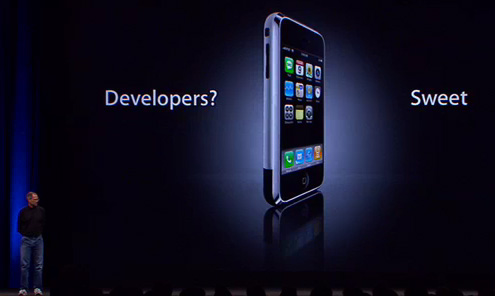
    Steve Jobs announced the iPhone development platform at last week's Worldwide Developer Conference to sighs of disappointments. Mac developers were anxious to develop new applications for the the most anticipated consumer electronics device in years, only to be told they should code fancy websites instead. The 9-minute iPhone development demonstration during the WWDC keynote was a bit confusing for anyone new to Apple widget development. In this post I'll break down a few Apple widget components, transport you to the iPhone development world, and explain a few restrictions and lock-downs common in the mobile phone industry.

    Dashboard under the hood

    Apple's Dashboard application acts as a bridge between web technologies and your desktop. Basic widgets contain HTML, CSS, and JavaScript describing widget structure, styling, and interaction respectively. Multiple widgets utilizing this same base technology form a single process group on OS X 10.5 (Leopard) and minimize the total amount of system resources (CPU, memory, etc.) required by each new widget.

    Dashboard widgets can access the local operating system's look and feel through the Apple JavaScript classes inside your system's WidgetResources directory. These specialized JavaScript resources expose a scrollbar, slider, buttons, animations, and widget flip controls specific to the operating system and Apple's UI of the moment.

    Apple Dashboard widgets may also tap into local resources such as your computer's iSight camera, your MacBook's current battery levels, songs in your iTunes libraries, or contacts in your Address Book. Any application may add a widget-plugin as a Cocoa bundle to allow widget access to application-specific data and functionality.

    Today's Dashboard widgets take advantage of web browsing technology, plugins, and local application resources exposed to the widget engine via specialized plugin interfaces. Dashboard is an part of your computer's Dock application. Dashboard widgets exist behind a single Dashboard icon; they do not have individually callable Dock icons out of the box.

    Dashboard experience ported to iPhone

    iPhone innovative applications

    What if Apple's desktop widget were ported to a mobile device such as the iPhone? The iPhone runs OS X, and contains the essential components necessary for widget operation on a mobile device.

    iPhone widgets would operate inside the mobile WebKit library. They would have access to device-specific UI elements such as stylized buttons, smooth transitions, and personalization options. Pieces of the underlying operating system and installed applications would be exposed via widget plugins. Widget files would be distributed as a bundle, downloaded to the iPhone over the air or via a tethered sync. Each widget could have access to limited system resources such as iPhone battery life, WiFi signal strength, the local Address Book, or the iPhone's built-in camera.

    iPhone developer features announced at WWDC

    There were two types of iPhone announcements at WWDC last week: public statements made by Steve Jobs and Scott Forstall during the conference keynote and NDA-bound statements to developers during conference sessions. I'll only cover the public statements in this post.

    iPhone developer features

    iPhone applications will "utilize the full Safari engine" and "look exactly like apps on the iPhone." Interpretation: Applications created for the iPhone will be powered by WebKit technology and have access to Apple-specific JavaScript libraries to create the look-and-feel of the underlying Apple OS. This behavior is similar to the current Dashboard experience.

    Write applications using Asynchronous JavaScript and XML (Ajax). Interpretation: The iPhone's web browsing technology supports XMLHttpRequest as a data retrieval method. This statement could also mean Apple will support JavaScript programmability of a local sandboxed CoreData store delivered as XML but that's more advanced and unlikely due to no current offline storage support on the desktop browser.

    "Integrate with iPhone services." You can make a phone call, send an e-mail, or lookup a location in the built-in Google Maps application from any web application. Interpretation: The iPhone's Safari browser contains the same data detection features for phone numbers, e-mail addresses, and address data seen in Mail.app in Leopard. This detected data can be passed into its default handler as an automatically-generated hyperlink. This statement could also mean WebKit applications will have access to special plugins created for system-level services similar to the desktop API but that may be too hopeful.

    "Instant distribution." "Easy to update." "Sandboxed on iPhone." Interpretation: Widget bundles are not stored on the iPhone. All files are retrieved from the a remote server and treated as a web resource. Your files are cached and have the same access restrictions as a standard public Internet site.

    Safari vs. widgets

    iPhone widgets are small applications powered by WebKit launched from the iPhone application menu. Web applications created by third-party developers for the iPhone are three clicks away from the same home screen -- Web, Bookmarks, bookmark name -- but have similar functionality. Personalization data such as stock tickers or your local ZIP code is stored inside a browser cookie.

    iPhone widgets store resource files such as images, HTML, CSS in the iPhone's local storage and update the entire widget with the operating system. iPhone widgets pull data updates such as stock prices or the latest weather report from a remote server or could also access locally stored data such as a dictionary.

    Safari-based applications request each resource from a remote server and poll for cache updates with each page load. If your weekly weather display contains a sun, cloud, and cloud with rain your application might poll a remote server for possible changes to each of the three images with every display of your weather page.

    AT&T or Apple restriction?

    Apple developers wanted at least iPhone widget-level application marketing and were visibly disappointed by Apple's keynote announcement last week. It's still unclear if AT&T or Apple is keeping third-party developers off the main app menu. I can only postulate based on existing developer programs from each company.

    AT&T certifies applications to operate on phones in its network across multiple operating systems. Productivity applications receive an enterprise solution certification after successfully passing security, reliability, and network usage tests and paying fees starting at $1000 a test. Enterprise applications are usually available for free and side-loaded (updated via a tether) by corporate IT departments. Consumer applications are typically distributed through AT&T's MEdia Net portal after similar testing and certification fees for a purchase fee split between AT&T and the developer. This process is the "orifice" Steve Jobs referenced in a 2004 Wall Street Journal interview.

    Current video iPods feature games purchased from the iTunes Store. Apple currently distributes 14 games created in-house and through external companies such as Astraware who specialize in porting games to PDAs and cell phones. The current iPod games platform is not open to third party or "homebrew" creations. Anyone can create their own iQuiz, using a specially formatted text file (essentially a fancy Note).

    New developers could enter the iPhone application menu through AT&T, Apple, or both.

    Ten days until iPhone

    The iPhone will be available at 6 p.m. on June 29, or a little over 10 days from the time I write this post. More developer documentation may emerge after the device's official release. Hardware and software hackers will likely pull the device apart in search of custom modifications already present on Palm Treo devices or the Sony PSP.

    Hopefully this long post clarifies the data we already know about applications and widgets on the iPhone. The device and its software was certainly under a tight release schedule and it's reasonable to assume new features are on their way in new versions of operating system hardware and software expected over the next six months. There is a developer story on the iPhone, but Apple has not communicated this story very well to their developer base over the past 6 months. They're battling the same closed carrier system as any other mobile application provider, so expect slow change assisted by market leverage.

  2. Jan09

    The end of Apple Computer

    Apple Inc Macworld 2007

    Today marked the end of Apple Computer after 30 years. The company has come a long way from kit computers assembled in a garage, capitalizing on at least one eureka moment a decade that causes people to rethink the intersection of cutting edge hardware and software. The release of the Mac in 1984 combined the best available hardware with commercial software utilizing the best ideas developed at Apple and research labs such as Xerox PARC. The release of the iMac in 1998 changed consumer views on personal computing, adding a colorful and quiet device to our desktops, placing an entire computer inside of a CRT encasement. The iPod's release in 2001 took advantage of the latest slim hard drives and a distinct browsing interface combined with software largely from other vendors. Today we saw the next step in the evolution of Apple, fully embracing its role as a software and service provider through the best integrated hardware experiences available on the market today.

    Limited quantities and price constraints have barely stopped Apple from making sweeping changes in the past. Today is the first major Apple event in recent memory where no announced products were available the day of the event. We'll have to wait a few months as hardware becomes approved, packaged, and made available in quantities capable of stocking Apple Stores around the world. Let's take a look at what Steve Jobs announced this morning and their implications for Apple and its developer community.

    iPhone

    Apple iPhone home screen

    Apple is now in the phone business, shipping its highly anticipated iPhone starting this June in the United States. The quad-band GSM phone runs Mac OS X, the same software sold with every Apple computer. Familiar desktop applications such as Safari, iChat, and Dashboard widgets take center stage on the phone, creating a familiar experience for new users synchronized over an Apple desktop conduit. On the go the iPhone will stay connected with EDGE cellular data or a WiFi connection when present. The iPhone features either 4 or 8 GB of flash storage (comparable to current iPod nanos) for $499 and $599 respectively. The iPhone has all the features of the iPod nano and then some, and could cause users to pay double for the combined features in a future upgrade cycle.

    The single biggest feature in my mind is OS X running on the iPhone. Apple will likely use its latest Leopard operating system, taking advantage of recommended resolution independence, core animation, and Objective C 2.0 on its 3.5" display. Apple abstraction layers for data storage, graphics display, and audio will become even more important components for any Mac developer wanting to reach the entire Apple audience from the iPhone to the Apple TV.

    Apple Dashcode dock icon

    Dashboard widgets take center stage on the new iPhone, appearing as individual application icons on the phone's home screen. Apple already has two IDEs ready for developers to deploy applications to the iPhone: Xcode and Dashcode. Dashcode will give any company or product the ability to create their own rich web application that lives outside the browser on both the desktop and the mobile device. Xcode will likely support a special compile mode in the future targeted at the resource constraints of the iPhone.

    The iPhone software may share a common browser with Nokia's WebKit-based S60 browser. The combined strength of the largest cell phone manufacturer in the world and Apple's design prowess (and reputation in the portable device space) will make the Internet functionality of the WebKit open source browser platform difficult to ignore.

    A full gallery of the Apple iPhone is available on my Flickr account.

    Apple TV

    Apple TV connectivity options

    Apple TV is the latest piece of Apple hardware powered by Intel processor. The Apple TV is a mini-computer connected to your home entertainment system and is specifically designed for multimedia playback and synchronization from across your broadband-enabled home network. The 40 GB hard drive will fill up fast, and will likely be used as local storage for your video and music playlists. The Apple TV can connect to other computers or the Internet using Ethernet or high-speed WiFi (802.11g or draft-n). Apple TV supports direct digital connections to your HDTV for lossless playback of your digital assets.

    The Apple TV does not include an optical drive such as Blu-ray or DVD, meaning it will not likely be the only playback device in your home theater rack. If you don't subscribe to cable and would just like to watch your favorite TV shows and movies from your couch the Apple TV will likely be the device of choice for the Apple fans downloading the latest episode of The Daily Show from the iTunes Store instead of through their local cable subscription.

    More in-person pictures of the new Apple TV are available on my Flickr account.

    AirPort Extreme

    AirPort Extreme connectivity

    Apple released a new version of their AirPort Extreme wireless base station, boosting Apple WiFi with five times the performance and twice the range of their previous model. The new AirPort base station supports 802.11n wireless technology currently in draft status and not expected to be a fully approved IEEE standard until 2008.

    Apple's AirPort Extreme can be connected to a USB hard drive for easily configured network attached storage. The extra networked storage is especially useful in a Apple TV household, serving your full media library even when you and your MacBook Pro are at a nearby cafe. The new Airport hardware also features time-based access control, letting you shut off Internet access for your kids during homework time or creating a public WiFi access when you are away from home.

    Summary

    Apple has redefined their company and product suite with today's hardware releases. Apple is now fully integrated with Intel hardware underneath their own operating system connecting you to Apple online services no matter where you might be. Apple Inc. is unifying its hardware and software platforms, powering the phone in your hand, the MacBook in your lap, or the Apple TV in your living room. Each piece of the Apple experience is connected to Apple's online services in the iTunes Store and .Mac synchronization and sharing.

    The one lagging piece in the grand Apple puzzle is .Mac online services. Will Apple revamp its online offerings to connect its new world beyond the personal computer? Over-the-air phone backup and synchronization is big business in Europe, and .Mac has not been pulling its weight with new competition from Internet giants Google and Microsoft. Apple needs to not only connect each piece of data on your devices through the cloud, but also back up your DRM certificates and/or assets to maintain consumer confidence in a digital lifestyle.

    We saw a lot of big news from Apple today at Macworld, but the expectations of the rumor mills still fell short. Will we see an ultra-compact MacBook Pro in the near-future? An Xserve for the home? Rumors and expectations will continue with high hopes as Apple fans stay tuned for that "One More Thing..."

  3. Aug29

    Eric Schmidt joins Apple's board

    Google CEO Eric Schmidt is now an Apple Computer board member. He joins Fred Anderson of Elevation Partners, Bill Campbell of Intuit, Millard Drexler of J. Crew, Genentech CEO Arthur Levinson, politician Al Gore, and Jerry York of Harwinton Capital.

    The group was already interconnected outside of the Apple boardroom. Al Gore is a Google advisor and Google invested in Current TV, Gore's television station. Bill Campbell was an early management advisor to Larry Page and Sergey Brin and helped hire Eric Schmidt. Arthur Levinson is on Google's Board of Directors.

    Are closer times ahead for these two powerful brands?

  4. Jun22

    Apple Store checks out with Windows

    Apple Store New York Fifth AvenueWindows embedded logo

    Apple is looking for ways to cut down on wait times at its stores' checkout lines and roaming WiFi-enabled processing stations in the hands of each employee may be the answer. The same employee helping you pick out the right set of headphones for your iPod can scan product barcodes and take payments via credit card right on the spot. Your receipt will sent to you via e-mail just in case you need to make a return or file an expense report.

    The handheld devices Apple uses in its store are powered by Windows. More information is available in a NPR Day to Day report on "maverick retailing" filed earlier this week.

  5. May23

    Nike+ iPod integration

    Nike+

    Nike teamed up with Apple to offer new products and services combined with the iPod nano. The new partnership will include electronics, clothing, and online services for people who like to listen to music while working out. Apple claims 50% of iPod owners use their music players during a workout. The new campaign is called Nike+ and features community and social networking components.

    The first product is the Nike+iPod Sport Kit, a $29 accessory connecting your shoe and your iPod. Runners can place a small sensor under their shoe insole and connect a receiver to their iPod nano to track statistics during and after their workout. Your workout progress and statistics such as pace, total time, and total distance are updated on-screen and with audio cues through your headphones. When you return to your desktop, sync your iPod nano and upload to Nike to track your progress over time and compare with friends. Nike will begin selling specially equipped shoes in June with a cutout for the sensor. Nike will also produce special apparel with an iPod nano pouch and headphone cord management.

    The experience begins during your workout, but doesn't end there. You can connect to the Nike+ website and track your running statistics and improvement over time, tracking your individual goals along the way. You can share your training information with others, and setup virtual races with friends to compare your times over the same course. Nike also launched a podcast to follow the progress of a marathon trainer in San Francisco. Perhaps in the future anyone could add their own audio to their workout blog and statistics.

    Not sure what to listen to during your workout? Nike athletes have contributed their favorite "PowerSongs" to get them pumped up.

    • Ronaldo: Elevation by U2
    • Landon Donovan: Where is the Love, Black Eyed Peas
    • Freddy Adu: Motivation by T.I.

    I think the new service will be extremely popular. If Nike opens up its data, allowing for easy sharing, personal trainers could follow the progress of their clients and tune workouts. The program is not limited to Nike shoes; other manufacturers could support a similar sensor cutout to pair with the workout tracker. $30 to obsess over workout statistics seems like a pretty good deal. Thanks Nike!

  6. May15

    iPod, the rejected startup

    Tony Fadell helped develop handheld devices for General Magic and Philips. Tony had a vision of a portable MP3 player complemented by an online music store. His startup, Fuse, couldn't get VC financing to build the product. He shopped the idea around to big companies such as Real Networks and only one company decided to experiment with his idea, hiring Tony as a contractor to build a prototype in two months.

    The first review on Slashdot in October 2001 called the product "lame" and "not very exciting" for lacking wireless and a bigger hard drive.

    The original iPod

    The product idea became the Apple iPod, and sold 125,000 units in its first three months and 14 million units in Q1 2006. It almost didn't happen, but Apple took a chance on a team they had worked with in the past to build something completely new.

  7. Jan24

    Disney buys Pixar for $7.4 billion

    Disney just announced the acquisition of Pixar for about $7.4 billion. 2.3 Disney shares will be exchanged for every Pixar share, including the shares of Pixar's largest shareholder, Steve Jobs, who owns 50.6% of all outstanding shares. Jobs joins the Disney board of directors as part of the deal which is expected to close this summer.

  8. Jan11

    Photocasts are not valid RSS

    I just bought a copy of Apple iLife 06 and created my first photocast of foodporn. The feed invents its own date format and places a guid at the channel level. Apple is also doing some odd user agent restricting access to browsers such as Firefox and tools such as Feed Validator.

    <pubDate>2006-01-11 18:55:03 -0800</pubDate>

    Perhaps Apple can publish an update to make all dates RFC 822.

    Apple also declared a new "wallpaper" DTD that is undefined, just like their podcast DTD.

    Tags: , , ,

  9. Sep08

    My new iPod nano

    iPod nano and iPod shuffle

    I arrived at the Apple Store in downtown San Francisco today right before the first shipment of iPod nanos arrived via FedEx. I had to wait a little while, but I am now the proud owner of an iPod nano 4 GB in black.

    I already have a 1GB iPod shuffle but my biggest frustration was not being able to see what I was going. I would often load my iPod shuffle with just a few tracks -- podcasts at the beginning followed by music -- to avoid not knowing where anything was. My shuffle barely ever contained over 100 MB as a result.

    Yes, the nano does fit in my change pocket. It's so tiny! It is perfect for my walk to and from work each day, and I am pretty sure it will increase my appetite for podcasts.

    Apple Store employees told me Apple had produced a special bag for the iPod nano, but it was still downstairs and not unpacked. The iPod nano should be the hot gift this Christmas, and marketed as a stocking stuffer because you never know where that box might turn up.

    Tags: ,

  10. Jan29

    Reserve a product at your local Apple Store

    Would you like to get your hands on the latest Apple product as soon as it hits your local Apple Store? You can go online at the store or from anywhere in the world to reserve a product when it becomes available. I used the system to reserve an iPod shuffle and I received a call today that the San Francisco Apple Store will keep one on hold for me until the end of the day.

    URL syntax is http://apple.webassociates.com/request/reserve.cfm?sid= + your local Apple Store ID. Visit the Apple Store retail page, select your nearest store, and note the store ID in the Genius Bar link. Build your URL as described above.

    Reserve a product from the Apple Store

    To reserve a product just enter your full contact information including a phone number. The same information is available from the "Contact Us" link in the Apple Store if you are worried about a spoofed site. You will receive a phone call when your item of interest is in stock and it will be placed on hold.

    • Posted on January 29, 2005 at 1:41PM
    • Updated at 10:57PM
    • By Niall Kennedy, a web technologist from
      San Francisco, California, United States

Niall Kennedy Niall Kennedy is a web technologist in San Francisco, California in the United States. I am very interested in the world of... MORE »

Search this weblog:

Subscribe:

Recently Popular

Archives: Popular Categories

Sites: More from Niall